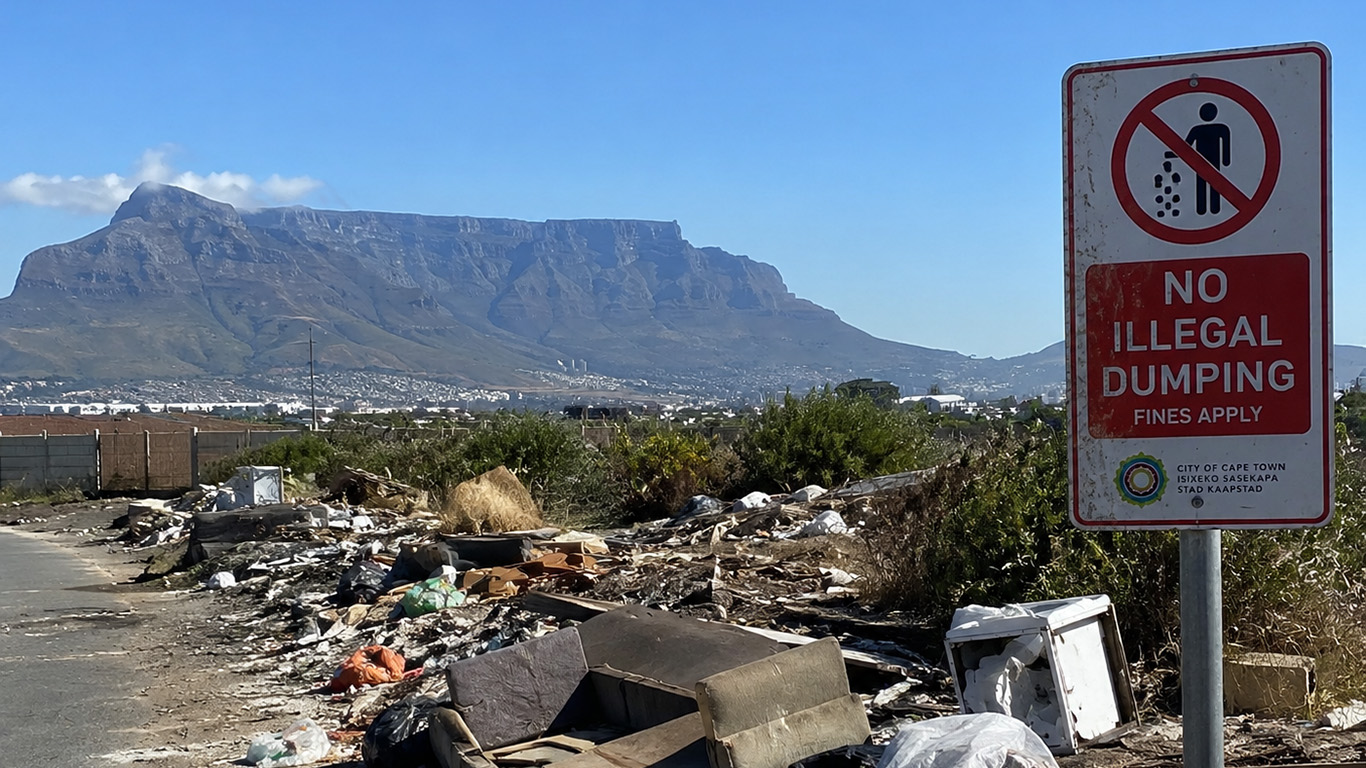
The Short Answer
Illegal dumping in Cape Town is the disposal of any waste from a handful of litter to truckloads of builders’ rubble in any location that is not an authorised waste facility. Under the City of Cape Town’s Integrated Waste Management By-law (2009) and the Urban Waste Management By-law, this is a criminal offence that can result in fines of up to R5,000, vehicle impoundment, or up to two years’ imprisonment.
If you’ve ever asked yourself, “Is it illegal to leave rubble on the pavement?” or “Can I dump garden waste in an open field?” the unambiguous answer is yes, it is illegal, and enforcement is intensifying every year.
From a junk removal company that disposes of junk responsibly
What the Law Actually Says
The primary piece of legislation governing waste disposal in Cape Town operates at two levels: national and local.
Nationally, the National Environmental Management: Waste Act (Act 59 of 2008) and the National Environmental Management Act (NEMA) set the overarching framework for waste management and environmental protection across South Africa.
Locally, Section 15(1) of the City of Cape Town’s Integrated Waste Management By-law is the key provision. It states clearly:
No person may drop, throw, deposit, spill, dump, store or in any other way discard, any litter or waste into or onto any public place, municipal drain, land, vacant erf, stream, water course, street, road, wetland, coastline or on any place to which the public has access, or otherwise dispose of it — nor may they allow a person under their control to do so.
That is an exceptionally broad definition, and intentionally so. It covers everything from dropping a chip packet to offloading a bakkie-load of broken tiles on a side road.
The by-law is enforced by the City of Cape Town’s Urban Waste Management (UWM) By-law Enforcement Unit, which works closely with Metro Police, Traffic Services, the Solid Waste Law Enforcement division, and Environmental Resource Management.
From a junk removal company that disposes of junk responsibly
What Counts as Illegal Dumping, And What Doesn’t
Many Cape Town residents unknowingly break the law. Here is a clear breakdown of what qualifies as illegal dumping versus what is permissible.
Illegal Dumping Includes:
- Builder’s rubble and construction waste — broken tiles, cement, bricks, sand, wood offcuts left on pavements, open land, or road verges
- Garden waste — grass cuttings, tree branches, or prunings left in public open spaces, rivers, or vacant land
- Household waste outside of designated collection — placing refuse bags outside your bin before collection day, or dumping them on vacant erfs
- Furniture and appliances — old mattresses, fridges, couches, and broken electronics left in public areas
- Rubble from renovations — even if left just outside your property boundary, this constitutes illegal dumping
- Waste dumped into water systems — rivers, canals, stormwater drains, wetlands, and the coastline
- Hazardous and chemical waste — paints, oils, batteries, and medical waste disposed of in any non-authorised location
- Commercial waste — businesses disposing of waste without proper collection contracts or permits
- Waste left on vacant erfs — even on private land you do not own, with or without the landowner’s permission (if the site is not a licensed disposal facility)
What Is NOT Illegal Dumping:
- Placing your household refuse bin at the kerb on your designated collection day
- Using an authorised City drop-off facility during operating hours
- Taking recyclables to a certified recycling depot
- Having garden services companies remove green waste through licensed channels
The key distinction is always the same: was the waste deposited at an authorised location by an authorised method? If not, it’s illegal.
From a junk removal company that disposes of junk responsibly
Where You Cannot Dump Waste
The City’s by-law explicitly prohibits dumping in or on:
- Public places — parks, pavements, squares, public open spaces
- Road reserves and verges — the strip of land between the road and private property boundaries
- Vacant erfs — both privately and municipally owned
- Stormwater drains and municipal drains
- Streams, rivers, wetlands, and water courses
- The coastline and beaches
- Any place to which the public has access
Practically, this means there is almost no outdoor location in Cape Town where dumping is permitted unless it is a licensed waste facility. Even dumping on your own vacant land (if it is not a licensed disposal site) may constitute an offence under NEMA.
From a junk removal company that disposes of junk responsibly
Fines, Vehicle Impoundment & Criminal Penalties
Penalties for illegal dumping in Cape Town are serious and have been escalating steadily as the City takes a harder line.
Spot Fines
A standard spot fine for illegal dumping is typically R2,500, though fines can range from R500 to R5,000 depending on the severity of the offence and the discretion of the enforcement officer.
Court-Imposed Sentences
For those prosecuted through the courts, the penalties are more severe. Under the by-law, a person found guilty may face:
- A fine of up to R5,000, and/or
- Imprisonment of up to two years
On a second or subsequent conviction, a minimum imprisonment sentence of one year applies unless the court finds substantial and compelling circumstances to impose a lesser sentence. First-time offenders may alternatively be sentenced to community service.
Vehicle Impoundment
This is the enforcement tool the City has used most aggressively. Under the Integrated Waste Management By-law, authorities are empowered to seize and impound any vehicle used in illegal dumping, and they do.
During the 2022/23 financial year, the City impounded 106 vehicles, more than double the 47 impounded the previous year. To reclaim an impounded vehicle, the owner must pay:
- The R5,000 dumping fine, plus
- An impoundment release fee of R8,700 for a first offence
- R11,700 for a second offence
- R17,400 for a third offence
Vehicle impoundment has proven highly effective as a deterrent, particularly against contractors and skip operators who dump rubble illegally rather than paying licensed landfill fees.
Compliance Notices
Beyond fines, the UWM Enforcement Unit also issues compliance notices, formal orders requiring the offender to remediate the dumped waste within a specified period or face additional penalties. In the 2023/24 financial year alone, the unit issued 1,280 compliance notices.
From a junk removal company that disposes of junk responsibly
The True Cost of Illegal Dumping to Cape Town
The scale of the illegal dumping problem in Cape Town is staggering, and the financial burden falls on every ratepayer.
The City of Cape Town spends approximately R100 million every year clearing illegally dumped waste funds that could otherwise be directed at service delivery, road maintenance, or community development. Historically, some estimates have placed the total removal and transport cost even higher, at around R350 million annually.
Enforcement has ramped up significantly in recent years:
- In the 2023/24 financial year, the UWM By-law Enforcement Unit issued 2,631 fines to a total value of R4,334,100 and conducted 55 special operations
- In the first half of 2023/24 (July–December 2023 alone), more than 8,000 fines were issued across traffic, law enforcement, and Metro Police departments
- In the three months of one enforcement drive, fines collected reached R1,615,100 for dumping and R176,000 for littering — a 115% increase on the prior year
The increase in enforcement reflects both the scale of the problem and the City’s growing willingness to use its legislative powers. As Alderman Grant Twigg, Mayoral Committee Member for Urban Waste Management, put it: “There is simply no excuse for illegal dumping.”
From a junk removal company that disposes of junk responsibly
Health and Environmental Hazards of Illegal Dumping
Beyond the legal and financial consequences, illegal dumping causes real, lasting harm to Cape Town’s people and environment.
Public Health Risks
Illegally dumped waste attracts vermin rats in particular, which carry disease and infection. Dump sites in residential areas have been directly associated with:
- Spread of disease through contaminated water sources
- Blocked drainage systems, which lead to flooding during Cape Town’s winter rains, flooding that endangers health and property
- Exposure to hazardous materials, including discarded chemicals, batteries, paints, and, in some cases, medical waste from informal settlements
- Fire hazards research into illegal dump sites in South African low-income neighbourhoods found that evidence of burning was present at approximately three-quarters of all dumps surveyed
Environmental Damage
- Water contamination: Waste dumped into rivers, stormwater drains, and canals ultimately flows to the ocean. The City has recorded a direct correlation between inland dumping and increased plastic pollution on Cape Town’s beaches
- Wetland degradation: Cape Town’s wetlands, many of which form part of the Cape Floristic Region, a globally recognised biodiversity hotspot, are vulnerable to contamination from dumped waste
- Soil contamination: Hazardous waste leaches into soil, damaging agricultural land and groundwater
Property Values
Research cited by the Woodstock Improvement District found that residents will pay up to 57% more to live in a clean neighbourhood. Illegal dumping directly suppresses property values and deters business investment in affected areas.
From a junk removal company that disposes of junk responsibly
Where You CAN Legally Dispose of Waste
A common excuse for illegal dumping is that legal disposal is too expensive or inconvenient. The City of Cape Town has worked to remove this barrier, and for most residents, it simply isn’t true.
City Drop-Off Sites (Free)
The City operates a network of free drop-off facilities across Cape Town. Key rules to know:
- Vehicles with a capacity of less than 1.5 tonnes can drop off up to three loads per day at no cost
- Waste must be sorted before arrival — unsorted or contaminated loads may be refused
- Accepted waste types include: builder’s rubble, garden waste, e-waste (at selected sites), and household hazardous waste (at Bellville and Athlone Refuse Transfer Stations, up to 50kg per person per day)
Major drop-off facilities include sites at Bellville, Athlone, De Grendel, Atlantis, Kensington, Welgelegen, and Prince George Drive, among others.
Important: Garden services companies are prohibited from using certain drop-off sites (De Grendel, Atlantis, Kensington, and Welgelegen). Check the City’s current drop-off schedule before visiting.
Recycling Depots
Recyclables, including paper, plastics, glass, and metals, can be taken to certified recycling depots throughout the city. Many community collection points are available in residential areas.
From a junk removal company that disposes of junk responsibly
How to Report Illegal Dumping
Cape Town’s enforcement depends heavily on community eyes. You can play a direct role in keeping your neighbourhood clean.
How to Report
City Call Centre: Call 0860 103 089 to report illegal dumping at any time.
What Information to Provide
Your report is far more effective and more likely to result in prosecution when you include:
- A photograph of the offender in the act (taken safely and without confrontation)
- The vehicle registration number of any vehicle used in the dumping
- The exact location (street address or GPS coordinates) where dumping occurred
- The time and date of the incident
- A description of the waste dumped
You may report anonymously if you prefer.
From a junk removal company that disposes of junk responsibly
Frequently Asked Questions
Is it illegal to leave rubble on the pavement outside my house?
Yes. The pavement is a public space. Builder’s rubble left on a pavement, road verge, or outside your boundary constitutes illegal dumping, regardless of how long it is left there. Arrange for a licensed contractor to remove it or use the City’s drop-off facilities.
Can my contractor dump rubble on a nearby open field?
No. Dumping on any vacant erf, open field, or land without a valid disposal licence is illegal. Your contractor could face a fine, vehicle impoundment, or criminal charges, and so could you as the property owner if you instructed them to do so.
Is it illegal to throw rubbish into a river or canal?
Absolutely. Depositing waste into any water course, stream, wetland, or drain is explicitly prohibited under the City’s by-law and constitutes a serious environmental offence under national legislation as well.
What about dumping on private property?
Dumping waste on private land (other than your own) without the owner’s consent is illegal under the by-law. Even with consent, if the land is not a licensed disposal facility, it may still constitute an offence under NEMA.
Can I dump garden waste in the bush or on the mountain?
No. Dumping garden waste or any waste in natural areas, including on Table Mountain National Park land, is illegal. It also poses a serious threat to the fynbos ecosystem.
What if I see someone dumping, but I’m not sure?
Report what you see to 0800 110077. Investigators will follow up. You can report anonymously and are not required to confront the person involved.
Are businesses treated differently from residents?
The same bylaws apply to both, but businesses face greater scrutiny because they typically generate larger waste volumes and are expected to have formal waste management contracts in place. Businesses without a compliant waste disposal plan may receive a compliance notice and be subjected to audit inspections.
In Summary
Illegal dumping in Cape Town is defined broadly by the City’s Integrated Waste Management By-law as disposing of any waste in any unauthorised location, from littering on a pavement to offloading rubble in a river. It is a criminal offence carrying fines of up to R5,000, possible imprisonment for up to two years, and vehicle impoundment costing thousands more to resolve.
The City is spending R100 million annually to clean up the damage, and enforcement is becoming sharper every year. In 2023/24 alone, over R4.3 million worth of fines were issued, and more than a hundred vehicles were impounded.
The good news: legal disposal options are free and widely available. The City’s drop-off network accepts up to three loads per day at no cost for most residents. There truly is no excuse for illegal dumping.
If you witness illegal dumping, call 0860 103 089 or report it via the City’s online systems. Your contribution helps protect Cape Town’s environment, public health, and the community you live in.
From a junk removal company that disposes of junk responsibly
1 thought on “What Is Considered Illegal Dumping in Cape Town?”